Inside the Startup Betting That Self-Driving Cars Will be adopted Faster in Latin America Than Europe

By Amrutha Killada, May 2026
In the global race to build self-driving cars, the spotlight rarely strays far from San Francisco, Shenzhen, or Munich. Billions of dollars, elite engineering teams, and regulatory chess matches dominate the narrative.
But Arturo Deza is making a different bet: that the future of autonomy might arrive sooner not later in places most of the industry has overlooked.
Not in Silicon Valley.
Not in Europe.
In Lima, Peru.
A Different Kind of Founder Origin Story
For Deza, this company didn’t begin as a market opportunity, it began as a question about identity.
As a kid in Peru, he dreamed of becoming a scientist, not just for the sake of discovery, but as a way to represent his country on a global stage. That dream took him to places like Harvard and MIT, where he built a career in research and academia as a Post-Doctoral research scholar in labs that have trained scientific CEO’s such as Amnon Shashua (MobilEye) and Demis Hassabis (DeepMind)
“I always thought I’d become a professor,” he says. “Run a lab. Contribute to science.”
Then the pandemic happened and quietly rewrote the rules.
Remote work collapsed geography. Talent became fluid. And for the first time, Deza realized he didn’t have to wait until the end of his career to return to Peru and build something meaningful.
So he accelerated the timeline.
Instead of staying in the U.S., he moved back to Lima with a goal that many investors would later call borderline irrational: build a self-driving car company in Latin America.
The “Analog Twin” Thesis
At the core of Deza’s thinking is a surprisingly simple idea, one that reframes how we think about global markets for autonomy.
“Latin America is almost like an analog twin of the U.S.,” he explains.
The roads look similar.
The infrastructure is comparable.
The driving systems lanes, stop signs, and traffic lights are nearly identical.
But there’s one key difference:
“It’s just more chaotic.”
And that chaos, he argues, isn’t a bug, it’s a feature.
Training autonomous systems in Latin America could produce models that are more robust than those trained in highly structured environments. If a system can handle Lima, it can likely handle San Francisco.
Yet despite this, most self-driving companies have ignored the region entirely.
Why?
Because they’re optimizing for purchasing power, not data richness or real-world complexity.
The Moment It Clicked
The idea didn’t start as a company. It started as an experiment.

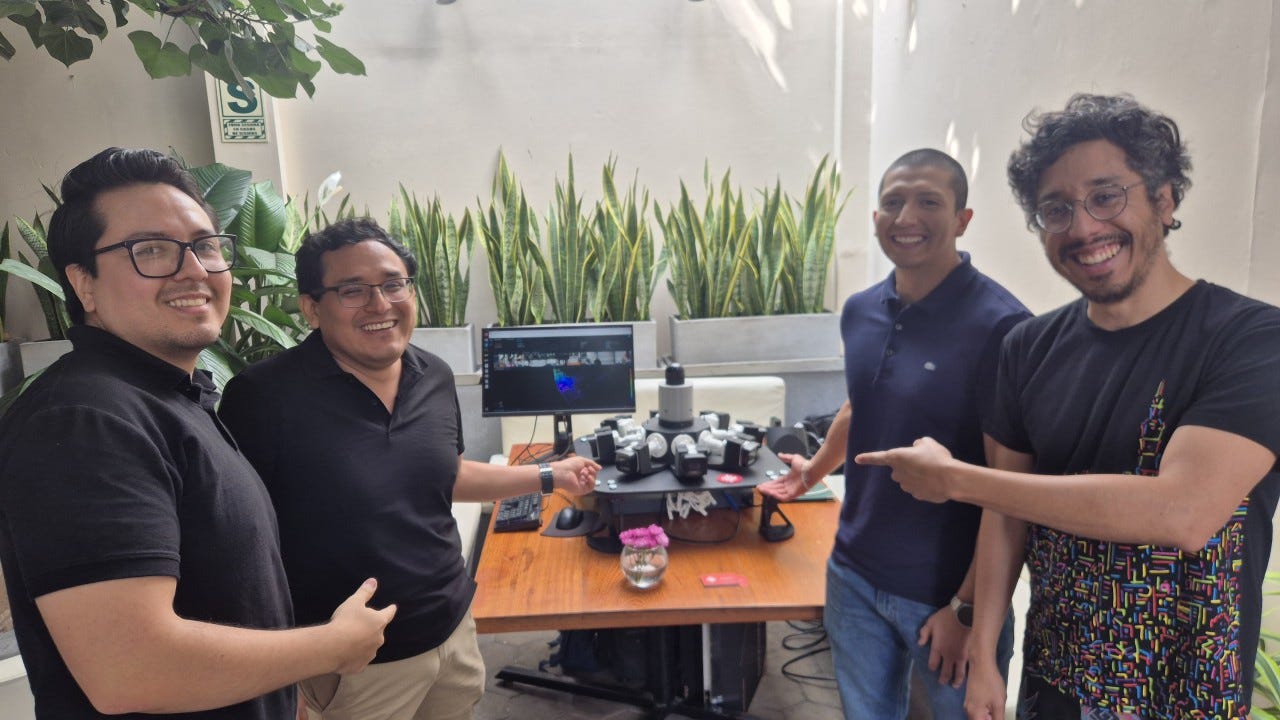
A few years ago, Deza and his co-founders David Ortega, Dunant Cusipuma and Victor Flores-Benites collected dashcam footage from Lima, Cusco and Cajamarca (key cities in Peru) and ran open-source autonomous driving models on top of it. They published their findings in a blog post.
It went viral.
Massively viral.
Over 400,000 likes. Memes. National press coverage. International coverage.
“To the extent that people thought there were already self-driving cars in Peru,” he says.
There weren’t.
But the reaction revealed something important:
People weren’t just curious, they were excited.
And then something else happened. Something Deza didn’t expect.
The local press assumed Artificio was an American company. The study was that polished. That credible. That convincing.
“That’s when we realized this isn’t just a thought experiment,” Deza says. “There’s a real demand and interest from the Latin American population that is a wildcard. Our study was also so well calibrated that the local press was convinced Artificio was an American company.”
For a team operating out of Lima, with no Silicon Valley address, no famous backers — that misidentification wasn’t an accident.
It was a signal.
“At that point, we knew that although the road would look difficult, we were heading towards the right direction.”
What Self-Driving Actually Looks Like Today
Public perception of autonomy is still shaped by sci-fi perfection, Level 5 vehicles gliding flawlessly through cities.
Reality is messier.
Today’s landscape splits into three main categories:
Urban robotaxis (like Waymo): navigating dense, unpredictable cities
Highway trucking: long, repetitive routes at high speeds
Industrial autonomy (like mining): controlled, high-efficiency environments
Each comes with its own challenges. But across all of them, one problem remains unsolved:
The unexpected.
“What happens when something truly unusual occurs?” Deza asks. “That’s where systems struggle.”
A child runs into the street.
A protest blocks a road.
A pedestrian approaches not to cross but to sell something.
Humans intuit context. Machines don’t yet.
Where AI Still Falls Short
To understand these gaps, Deza’s team has been running experiments comparing human judgment with modern AI models.
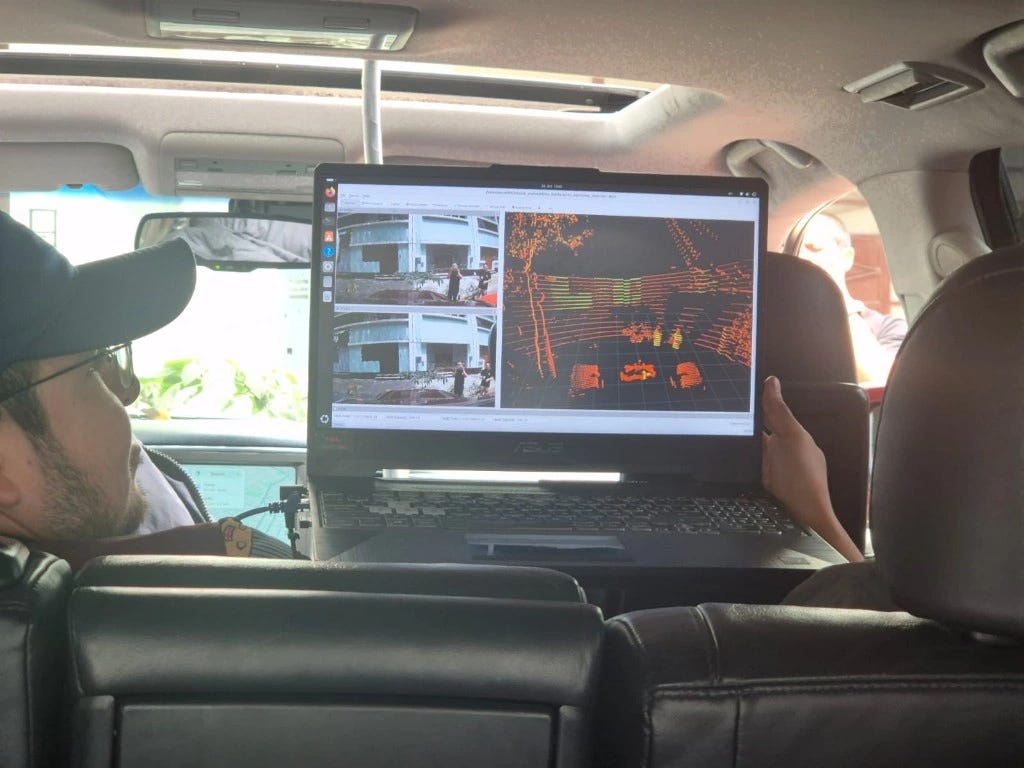
They feed real-world driving footage from Lima and New York that their company has collected into vision-language models and ask questions like:
How many pedestrians are present?
What would have to happen next for an accident to occur?
How likely is this driving scenario?
The results are revealing.
In one case, a model observed two individuals approaching a car in Lima. Humans immediately recognized the context: street vendors asking for money.
The AI?
It simply labeled them as “pedestrians.”
“The model understands objects,” Deza explains. “But not intent nor context”
That gap between perception and cognition is where the real challenge lies.
Why Now Might Be the Right Time
For years, building a self-driving company required massive capital and closed proprietary systems.
That’s changing.
Open-source models, accelerated AI tooling, and companies like Nvidia releasing foundational systems have dramatically lowered the barrier to entry.
“Ten or fifteen years ago, this would’ve been impossible,” Deza says.
“Now, the entire software & AI pipeline is accelerating.”
While Arturo held a faculty position at UTEC in Peru -- in parallel to running his start-up -- he gave his students a challenge: to have the small robot navigation kits complete a small F1- driving maze for cars, and invited groups to try between two approaches:
Traditional computer vision such as object detection models in conjunction with mapping and SLAM.
Modern AI models via API calls (think asking ChatGPT for driving instructions after uploading a frame).
The result?
“The modern AI-based system outperformed the classical approach,” he says. “That’s when it clicked, with proper calibration data and higher controls, this could actually work at a larger scale, rather than a toy-like scenario.”
The Hardest Part Isn’t the Tech
You might expect the biggest challenge to be engineering.
It isn’t.
“The hardest part has been raising capital,” Deza says.
Latin American investors often lack deep-tech experience.
U.S. investors understand the tech but hesitate on geography.
The result is a funding gap where neither side fully leans in.
“It’s not that anyone is wrong,” he says. “It’s just a mismatch.”
Ironically, regulation, a major bottleneck in Europe, has been relatively permissive in Peru. Authorities have allowed testing as long as a human remains in the loop.
A Contrarian Bet on Adoption
Perhaps Deza’s most controversial belief is this:
Self-driving adoption may happen faster in Latin America than in Europe.
At first glance, it seems counterintuitive. Europe has more wealth, better infrastructure, and established markets.
But adoption isn’t just about capability, it’s about culture.
In Europe, skepticism toward foreign technology and strict regulation slow deployment.
In Latin America?
“There’s a strong openness to new technology,” Deza says.
And then there’s pricing.
While most companies aim to undercut human drivers, Deza believes the opposite strategy might work in Peru:
Charge more.
Position autonomy as a premium experience.
“People will pay for it,” he says. “They just don’t know it yet, because the option hasn’t presented itself.”
What Comes Next
In the next year, the company is focused on two milestones:
Technical: Deploy a small-scale autonomous prototype even if imperfect
Commercial: Launch a pilot with a luxury vehicle equipped with sensors, operated by a human driver, to test demand and pricing
It’s a deliberately scrappy approach: rent cars, install sensor stacks, collect data, iterate.
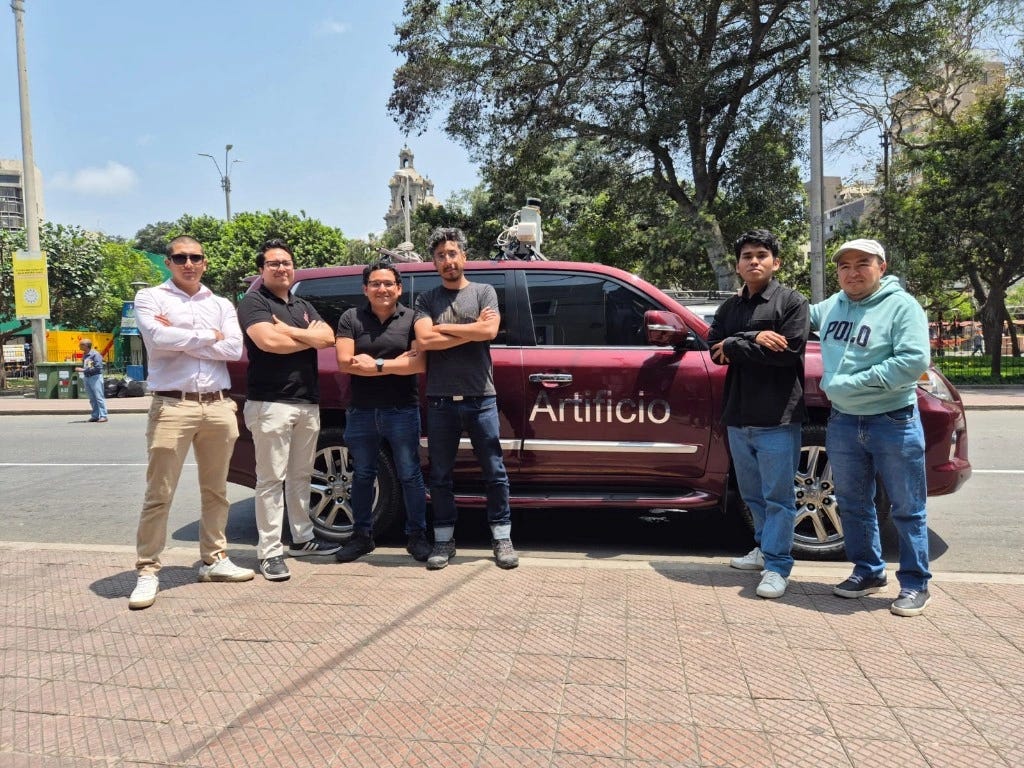
On mapping days, the team drives through Lima with visible hardware mounted on the vehicle.
“People think we’re Google Maps,” Deza laughs. “They take selfies, and will chant ‘Mira, ahi esta Google!’ (Look, the Google team is here!) -- even if we have a big Artificio logo on our car. It’s always a spiritually fulfilling experience to take the car out for a spin because we get to drive the car around the all the neighborhoods in Lima, and the reaction no matter the place is always wonder and curiosity, as if by virtue of trying, we have already succeeded to inspire the next generation of engineering and scientific talent in the country ”
More Than a Startup
For Deza, this isn’t just about building a company, it’s about rewriting a narrative.
“Latin America is known for food, tourism, music,” he says. “Not technology.”
He wants to change that.
To prove that world-class, frontier technology can be built anywhere, not just in Silicon Valley.
And that sometimes, the hardest problems are worth pursuing precisely because they’re hard.
“Someone is going to do this,” he says.
“It might as well be us.”